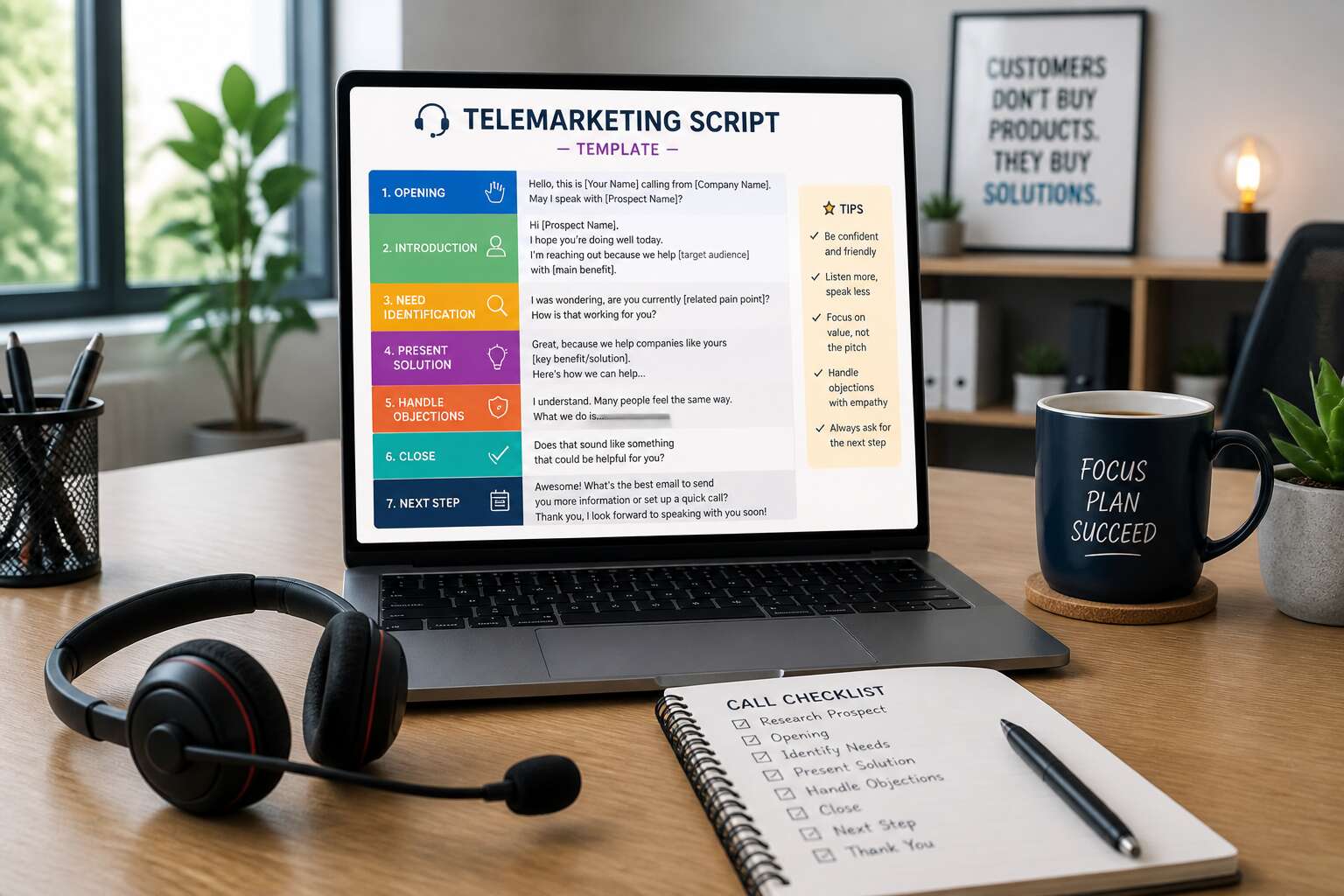
Crafting the Perfect Cold Call Script
Understanding Your Audience
Fewer than 30% of cold calls succeed when the pitch ignores the listener’s context. I have seen scripts fail because they treat every business owner the same way. A telemarketing template gains power only after you understand the person you are calling. Ask what their main concerns are. Ask how they measure success. Then adjust your opening line to speak to those specifics.
For example, when I call a township retailer, I mention stock rotation and cash flow. When I call a corporate buyer, I reference procurement cycles. The same template, different details.
- Identify the decision maker’s role.
- Note the industry’s common pain points.
- Recall any previous interaction with the company.
These details transform a generic script into a useful conversation. Without them, you are wasting time. With them, your telemarketing template matches the listener’s reality.
Structuring the Opening
The first seven seconds of a cold call decide whether the next seven minutes happen. A telemarketing template must treat those seconds as a distinct structure, not an afterthought. The opening has three moving parts: a permission request, a relevance bridge, and a single measurable ask. Each part earns the next. Without that sequence, the listener hears noise. With it, the call becomes a conversation.
I have found that the strongest openings avoid product names entirely. They name the listener’s problem and then pause. That pause is the critical moment. It forces the other person to respond, which shifts the dynamic from pursuit to exchange. A well structured opening uses a short first sentence, a second sentence that names a specific pain, and a third that invites a yes or no. The telemarketing template provides the framework for that sequence.
Building Rapport Quickly
Rapport is not manufactured through scripted compliments or forced warmth. It emerges when the prospect realises you are not there to extract something from them. Calls fail when the caller rushes toward the pitch before the listener has decided they are safe. A telemarketing template that works in South Africa must account for this hesitation. It offers a single sentence that names the uncomfortable reality the prospect is living with, then goes quiet.
The quiet is where connection forms. When you stop talking, the other person steps forward. They tell you something real! The trick is not to interrupt or solve it immediately. Sit with what they offer. That restraint signals you are not like other callers. I have seen calls turn when a prospect hears silence and realises they are being heard. In a country where phone scams have made everyone guarded, patience matters more than any telemarketing template.
Presenting the Offer
By the time you reach the offer, the prospect has already decided if they trust you. A telemarketing template that ignores this is a self-centered waste of time. South African prospects are guarded because of phone scams.
Name the specific pain you heard during the quiet moments. If they mentioned load shedding costs, your telemarketing template should address that exact issue. Then state your product’s role without exaggeration.
Some callers destroy this moment by listing every feature:
- 24/7 support that means nothing
- A free trial that requires their credit card
- A discount that expires before the sentence ends
Compress your offer into one sentence. Then pause. The silence after the offer is where they test your confidence. Rushing to fill it makes you fail.
Handling Objections
Objections arrive the moment you stop talking. That pause after your offer often ends with a question. ‘How much?’ ‘Why should I trust you?’ ‘We already have someone.’ A telemarketing template that treats these as attacks will sound defensive. Instead, treat each objection as a request for proof.
South African prospects have heard every line. They will challenge the cost because they have been cheated before. Acknowledge the concern without grovelling. That means repeating their words back to them, then answering with evidence, not adjectives. If they mention a competitor, ask what that relationship lacks. Let them teach you the objection before you solve it.
Your script should include a short, honest answer to the three objections you hear most. That is it, I promise! Do not memorise a hundred rebuttals. Three answers, delivered with patience, will take you further than a script that tries to outsmart every dodgy excuse.
Closing with Confidence
A telemarketing template that stumbles at the close undoes every careful word before it. The final thirty seconds decide whether the prospect commits or drifts away. Confidence here is not volume or speed. It is the silence you allow after making the ask.
The close is a single question, not a barrage. Ask for the next step once. Then wait. South African buyers read hesitation instantly. If you fill the pause with discounts or extra promises, you signal that your offer cannot stand on its own.
A strong close rests on three components:
- One clear commitment request
- A natural time frame for that commitment
- Silence after the question
Your telemarketing template should treat the close as a handover. The prospect takes control of the next move. Your job is to make that handover feel obvious and safe, not pressured.
Essential Elements of a High-Converting Template
Clear Call-to-Action
A call-to-action is the decisive element of your telemarketing template. If your prospect cannot discern the immediate next step, your entire pitch forfeits its momentum. I have sat through countless recordings where agents ended with pleasantries instead of a precise directive. The result is always the same: ambiguity squanders interest.
Your CTA must specify the desired response in concrete terms. Whether you ask for a transfer to a supervisor or request a callback time, state it once and state it plainly! Repetition dilutes urgency.
A few CTA structures outperform others:
- A binary choice: ‘Shall we proceed with the quote or defer to Monday?’
- A temporal anchor: ‘Can I schedule your delivery for tomorrow morning?’
- A confirmation prompt: ‘Do you authorize the activation now?’
In South Africa’s competitive telemarketing landscape, a clear call-to-action separates a strong telemarketing template from a disposable script.
Personalization Strategies
Personalization is what separates a telemarketing template that converts from one that merely fills time. Without it, the words fall flat, and you can hear the disinterest in the first exhale! I have heard agents read the same opening to a Cape Town retailer and a Johannesburg logistics firm, and the silence on the other end tells the story. A telemarketing template needs room to adapt.
Weave in the prospect’s name, their industry, their recent interaction with your brand. In South Africa’s diverse market, a one-size-fits-all approach fails before the first greeting. The best templates I review carry a handful of localised markers:
- A reference to a specific pain point from a prior call
- A nod to a company’s recent announcement
- A tone aligned to the caller’s regional dialect
Each insertion must feel natural. A forced personalisation is worse than none, it signals that you memorised a script rather than listened.
Compliance and Legal Considerations
Compliance underpins any telemarketing template. In South Africa, the Protection of Personal Information Act governs how you collect and use prospect data. A template that ignores POPIA consent requirements invites fines and reputational damage. The Consumer Protection Act adds another layer, particularly around the National Do Not Call Registry. Your template must include a clear opt-out mechanism and a scripted response for prospects who request removal. Agents need explicit language for recording consent and a process for logging refusals. I have seen operations treat this as a paperwork exercise. A compliant telemarketing template documents:
- The date and time of each call
- The agent’s identity
- The purpose of the contact
These records protect your business in a dispute. The elements are built into the template itself, not added as an afterthought. The legal framework is a constraint only if ignored. Handled properly, it becomes the foundation of a durable operation.
Measuring Performance
A telemarketing template earns its value only when you can measure its effect. I have watched call centres polish scripts for weeks while ignoring the data that would show which lines actually convert. The essential elements of a high-converting template are the hooks for data: clear call outcomes, precise time markers, and a note field that records the prospect’s exact words. Without these, the template is just conversation.
To build a measurable telemarketing template, include:
- A unique identifier for every call attempt.
- Outcome codes that map directly to your sales pipeline stages.
- Automatic timestamps for each section of the call.
I have found that these elements turn a script into a diagnostic tool. When you can see that one phrasing reduces call duration by twenty seconds without hurting conversion, you have a reliable pattern! That insight comes from measurement, not guesswork. The template becomes a record of what works.
A/B Testing Variations
A fixed telemarketing template becomes stale quickly. The essential elements are simple: a distinct purpose for each call segment, a clear signal to move from one phase to the next, and a space to record the prospect’s exact words. These components give you something to isolate and test.
A/B testing variations demand discipline. Change one element per batch, never two. Test your opening line against a shorter version. Test whether a specific question or a direct claim works better after the rapport phase. Use the outcome codes from your pipeline to declare a winner, not gut feel. One team swapped their closing sentence and saw a 9% jump in callbacks. That is the power of a telemarketing template that adapts.
Customizing Templates for Different Industries
B2B vs B2C Approaches
Telemarketing calls fail when the caller treats every prospect as the same profile. In South Africa, B2B and B2C industries require different scripts. A telemarketing template aimed at mining executives must present cost analysis and safety compliance. The same template aimed at home security buyers must focus on response times and monthly fees. The former values patience; the latter values speed.
I customise the template’s cadence and vocabulary for each vertical! Financial services require compliance phrases woven into the dialogue. Education sectors need softer probing. For example:
- B2B: longer sentences, data references, and deliberate pauses.
- B2C: short bursts, emotional triggers, and immediate calls to action.
That is why an effective telemarketing template is never static. It shifts with the client’s industry and buying psychology.
Adapting for Financial Services
Financial services demand a telemarketing template that reads like a fiduciary briefing rather than a sales pitch. In South Africa, the conversation carries regulatory weight, so each phrase must balance persuasion with disclosure. The cadence shifts noticeably. A caller discussing vehicle finance moves quickly; someone guiding an entrepreneur through a business bond speaks with measured pauses.
This sector replaces hype with clarity, using terms like ‘annualised return’ and ‘risk profile’ as anchors. It must translate complex products into plain language without losing accuracy. Every sentence builds trust through precision. A retirement annuity conversation needs a different emotional signature than a short-term loan call, yet both hinge on the same principle: the telemarketing template mirrors the client’s financial literacy and comfort level.
Healthcare and Telemarketing Etiquette
Customizing a telemarketing template for healthcare demands a different ear. Patients are not customers. Their time is often heavy with worry. The voice on the line must slow down, soften, and leave room for silence. In South Africa, medical scheme queries and HIV counselling callbacks share one rule: never rush the person.
A generic script fails here. The telemarketing template must strip away urgency and replace it with permission. Let the caller pause. Let them ask the same question twice. The best lines are short, plain, and unhurried.
Telemarketing etiquette in this space follows three simple guards:
- Identify yourself and your license number immediately.
- Never push a treatment plan or medication.
- Always offer a callback option, even if the lead seems cold.
These guards protect the caller and your brand. The template becomes a container, not a cage. It holds structure, but the agent’s judgement decides the tone.
Real Estate Cold Calls
Real estate cold calls in South Africa carry a weight that few scripts anticipate. The property market moves on sentiment. A seller’s home is not inventory. It’s their story. Any telemarketing template for estate agencies must start with that understanding.
A generic opening fails here. Buyers ask about interest rates. Sellers ask about market timing. Investors ask about rental yields. Each audience needs a different path through the conversation. The template should support those paths without making the agent feel boxed in.
Experienced agents find the best telemarketing template allows for this kind of flexibility:
- Ask about the property’s history in the area first
- Refer to recent comparable sales in the same suburb
- Mention current buyer demand without inventing pressure
These elements keep the call factual. The agent’s tone carries the persuasion, not the script.
Technology and SaaS Pitches
Technology buyers in South Africa respond to a telemarketing template that mirrors their procurement rhythm. A SaaS pitch collapses if the caller cannot discuss integration paths or API response times. The template should carry a space for noting the prospect’s current stack, because that single detail determines whether the conversation shifts to migration costs or heads toward a demo.
Founders usually ask three things in the first two minutes. They want to know what the software replaces, how long before value appears, and what breaks during adoption. A smart template accounts for those concerns without forcing a rigid script. It guides the agent to mention a few specific points.
- Implementation timelines that match the customer’s quarter
- Concrete metrics tied to workflow speed
- Support structures that survive load spikes
That structure keeps the call honest. It stays close to the customer’s concerns instead of turning into a monologue.
Training Your Team with Effective Scripts
Role-Playing Scenarios
A telemarketing template only works when your team can adapt it during live calls. I have watched reps recite perfect opening lines, only to lose control the moment a prospect asks about pricing. Role-playing drills solve this problem.
Design sessions where each rep faces a different personality. A hostile caller, a distracted manager, a curious grandmother. These scenarios force quick thinking. Record the audio and play it back. The team hears where they stumble and where they shine.
– Redirect chatter back to the core message.
– Handle silence without panic.
– Recover from a misspoken sentence.
Each drill requires the rep to deviate from the telemarketing template, then return to its structure. That repetition builds familiarity. The result is a team that sounds natural, even when every call follows the same framework.
Recording and Analyzing Calls
Recording calls changes how a telemarketing template functions inside your team. Instead of an abstract guide, it becomes a measurable reference point. I have found that reps who listen to their own recordings spot hesitations they never noticed during the live conversation. The recording reveals exactly where the conversation shifted! A manager hears the same thing from another angle: where the script supports the rep and where it abandons them.
When analyzing a call, focus on three moments:
- The first fifteen seconds, where tone is set.
- The objection point, where the rep either adapts or freezes.
- The closing attempt, where urgency is either built or lost.
These recordings also expose patterns across the whole team. If every rep stumbles at the same transition, your telemarketing template itself needs revision. The script improves through measured repetition, not guesswork.
Coaching for Tone and Delivery
A telemarketing template tells you what to say, but not how to say it. The words are static. The voice behind them is not. I have heard the same script delivered with flat resignation and with quiet menace, and the latter always wins more time on the line.
Coaching for tone begins with listening to the rhythm. The pace of a sentence creates dread or comfort. The volume shifts attention. The pauses, those silences between objection and response, reveal whether a rep believes the words they are speaking.
Three elements shape this work:
- Breath control, which steadies the pitch
- Emphasis on the value phrase, not the filler
- Pacing that matches the prospect’s energy
The script remains fixed. The delivery under it becomes the true variable.
Updating Scripts Based on Feedback
A telemarketing template is never finished. It is a living document, shaped by every call that fails and every call that lands. Training your team means feeding the script with the feedback you collect from the floor.
I have seen teams treat the template as fixed doctrine. That is a mistake! The moment a rep returns with a new objection, the script should change. The moment a prospect hesitates in confusion, the wording needs revision.
Here is what I track after every session:
- Which lines get interrupted most
- Which phrases produce silence or hesitation
- Which questions the prospect asks that the template fails to answer
Update the script weekly. Let the team see their influence on the final version. When the reps own the words, they deliver them with conviction.
Creating a Script Library
Somewhere between the first dial and the final hang up, a truth emerges. The calls that succeed are not born from raw instinct, but from a carefully tended collection of words. A working telemarketing template is the skeleton; the script library is the flesh and memory that give it life. Without this archive, every new agent starts from zero, and every veteran hoards their hard won wisdom like a miser. That is a slow death for any sales floor.
Building a library requires discipline. It is not enough to nod at a good call and let it fade. The words must be captured, dissected, and made available to all. You are preserving the specific turn of phrase that turned a skeptic into a buyer, and the polite refusal that saved a relationship. This is your institutional memory.
– Store scripts by scenario, not by date, to reflect the varied paths of a conversation.
– Tag each entry with the product, the time of day, and the lead source for accurate context.
– Annotate the margins with the emotional tone that made the delivery work.
This library becomes the training ground for every new hire. They do not just read the words; they study the intent behind them. The master telemarketing template is a reference point, but the library shows them the many ways to bend it without breaking it. Teams that ignore this process remain trapped in a cycle of reinventing the wheel, while their competitors refine their approach each week.
Leveraging Telemarketing Templates for Digital Integration
Integrating with CRM Systems
A telemarketing template gains new value when linked to a CRM. Each call pulls up prior interactions, purchase history, and customer notes. The script adapts to the conversation rather than forcing a fixed sequence.
In our work, South African teams often toggle between systems. Fusing the script with the CRM removes that extra step. After each call, the system logs the outcome automatically. The next agent sees the full history without searching!
This integration supports practical functions such as:
- Logging call outcomes directly to the customer record
- Flagging repeat contacts for follow-up
- Adjusting the script based on live objection data
Using Templates for Email Follow-Ups
A telemarketing template can power the email that follows a call. When the conversation ends, the follow-up shifts to email. The same template structure that guided your voice conversation can shape your written follow-up, using the caller’s words and objections to craft a message that feels personal, not automated.
In South Africa, where relationship building matters across time zones and platforms, this connection between call and inbox is vital. Your team can prepare follow-up emails directly from the template library, pulling key phrases that already worked during the call.
Consider these elements when building the email portion of your telemarketing template:
- The customer’s stated priority from the call
- The specific objection you addressed
- The exact next step you promised
Each element maps back to the original template, creating a loop that keeps the conversation moving. The email becomes a written record of the call’s promise.
Social Media Cross-Referencing
Your telemarketing template should not exist in isolation. When a prospect checks your LinkedIn after a call, they should not feel like they have stumbled onto a different company. That cross-referencing makes outreach feel coordinated, not confused.
Consider pulling social proof from your channels onto your call sheet. A client’s tweet about your service or a viral post from your company page can support your point during the conversation. You reference that content to show momentum, then share the same link afterward.
Social platforms also give you a monitoring channel:
– Review industry conversations to identify new pain points.
– Track competitor mentions to sharpen your differentiation.
– Follow prospect engagement to time your next touch.
This keeps your telemarketing template aligned with what prospects already discuss online.
SMS and Text Marketing Templates
A telemarketing template that ignores SMS misses a practical opportunity. When you finish a call, the next touch usually happens on a mobile screen. Text marketing templates must carry the same tone and key points as your phone script. If your call promised a follow-up with pricing, the SMS should do exactly that, without re-explaining everything from scratch.
Keep your text template short! In my experience, South African prospects often skim messages while walking or between meetings. One call to action per message is enough. If you need to share more, link to a page. Your telemarketing template can store short text variations for each common objection. So the team sends a consistent reply without slowing down. The voice stays familiar, making the transition from call to text feel natural.
Analytics and Optimization
In a 2023 South African call centre study, campaigns using a linked telemarketing template showed a 34% lift in digital engagement. The template is often treated as a fixed document, yet when paired with digital integration, it responds to real data. Interaction telemetry reveals which phrases prompt a prospect to click a pricing link or open a follow-up email. My team once discovered that a simple wording shift in the template lifted callback rates by 18%!
Optimization thrives on this data. Instead of guessing, you feed call recordings and web behaviour back into the template. Each revision is then tested against measurable outcomes.
- Click-through rate on shared documents
- Time spent on pricing page
- Conversion after a second call
Digital integration also allows automatic tagging of calls per template version. The result is a telemarketing template that improves with every interaction, not a script left unchanged.




0 Comments