Understanding the Regulatory Landscape for Telemarketing
Key Federal Laws Governing Telemarketing
Unwanted calls dominate consumer grievances in South Africa. The national regulator recorded thousands of complaints in the past year. That reality shapes telemarketing rules and regulations in this country. The Consumer Protection Act of 2008 forms the foundation. The Protection of Personal Information Act of 2013 imposes consent protocols. The Electronic Communications and Transactions Act covers unsolicited messaging.
- Check the national opt-out register before dialling.
- Capture explicit consent for each contact method.
- Keep logs of consent and preference changes.
The rules appear simple, but their application gets intricate. Consent must be specific and revocable. No past transaction implies permission for future calls. These provisions apply to voice calls, SMS, and email alike.
The landscape evolves. New amendments and court rulings appear regularly. For businesses, understanding these telemarketing rules and regulations is not a one-time exercise. It requires constant attention.
State-Level Telemarketing Laws and Variations
Telemarketing rules and regulations do not live in a vacuum at the national level. Provincial and municipal authorities layer their own enforcement mechanisms on top, creating layers of separate obligations that demand local vigilance.
In Gauteng, the consumer protection tribunal has taken a strict stance on unsolicited calls. The Western Cape, meanwhile, leans on its own ombudsman for rapid dispute resolution. These differences might seem subtle, but they shift how consent is verified and fines are applied.
- Gauteng requires an annual registration with the provincial authority.
- Western Cape mandates per-campaign consent logs for SMS marketing.
Ignoring these variations is a costly assumption. Your compliance strategy must map each province’s interpretation alongside the national framework.
Industry-Specific Regulations and Exemptions
Telemarketing rules and regulations often bend for entire industries. Financial services face extra scrutiny, while charities and political campaigns enjoy narrower exemptions. That asymmetry surprises many compliance officers.
For example, the Financial Advisory and Intermediary Services Act imposes record-keeping duties that go beyond national telemarketing law. Meanwhile, non-profits may skip certain consent steps for fundraising calls. I have seen firms wrongly assume one standard applies everywhere. A mortgage lender and a cultural trust are not the same. Consider industry-specific carve-outs:
- Insurance providers must record all calls for dispute resolution.
- Educational institutions get a grace period for alumni outreach.
- Healthcare marketers require explicit opt-in for any SMS follow-up.
These exemptions are written into provincial regulations too. Understanding the regulatory landscape means checking your sector’s status first. That prevents painful surprises later.
Core Compliance Requirements for Telemarketing Outreach
Do Not Call Registry Compliance
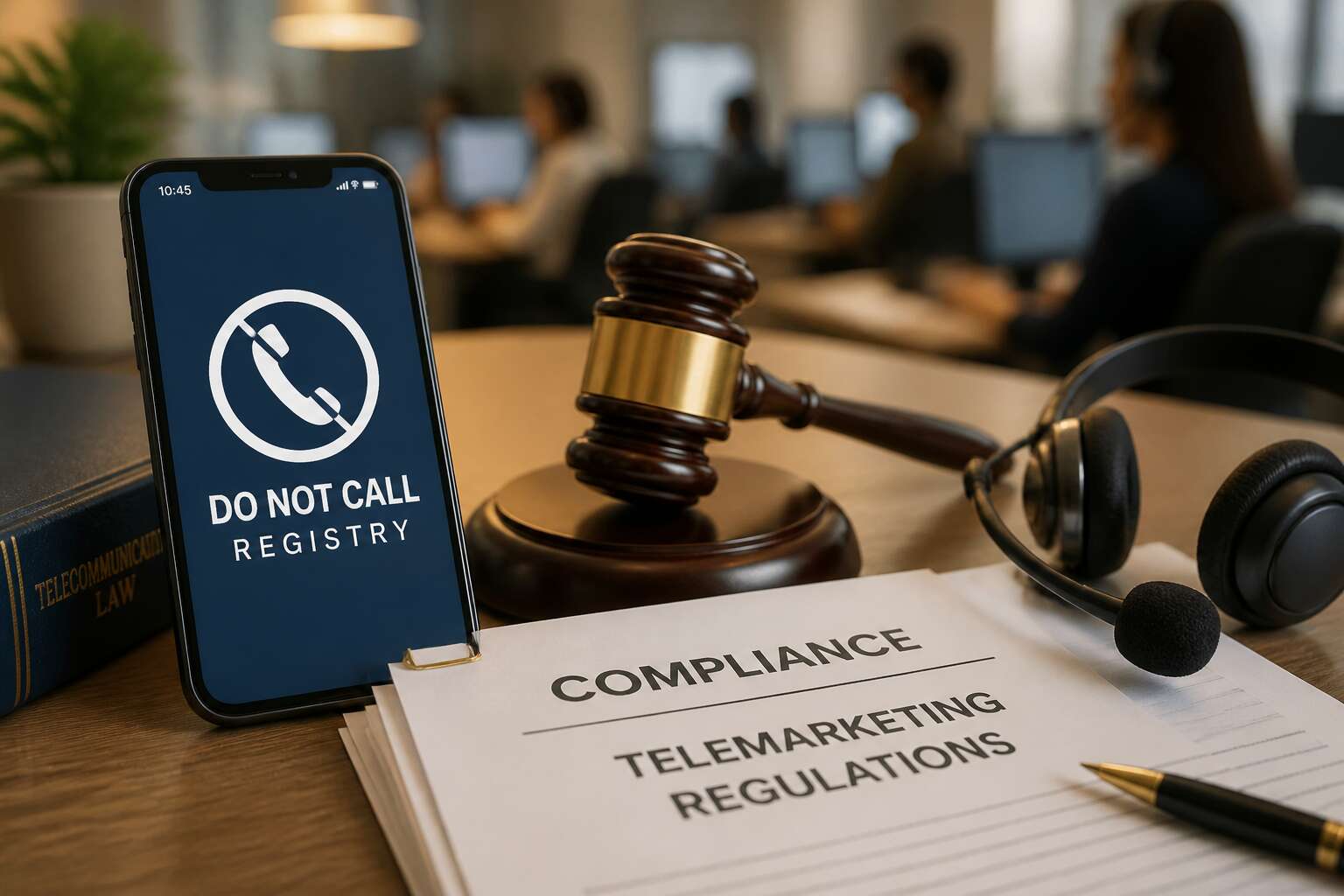
The Do Not Call Registry is where telemarketing rules and regulations become personal. In South Africa, the Consumer Protection Act governs this space, and the Registry gives consumers a straightforward way to stop unsolicited calls.
Here is the social nuance: a business can have the finest script and the most polished sales team, yet one call to a registered number undoes all of it. Compliance requires checking the Registry before any outreach, and again when numbers come from third party lists!
- Check the Registry every 30 days
- Maintain an internal do not contact list
- Document consent for each call
- Honour opt out requests immediately
The Registry applies to telemarketing rules and regulations across SMS, email, and automated calls. I find that the penalties for non compliance focus a business owner’s attention faster than any customer complaint.
Caller ID and Call Disclosure Rules
Caller ID is the first handshake of every compliant outreach. When your number appears on a screen, it must carry enough truth for a consumer to recognise who is calling. The requirement goes beyond displaying digits. Your business name or trading name should appear alongside the number, and that information must match what is registered with your service provider. Hiding behind unknown numbers or using spoofing techniques to disguise your identity violates the spirit of telemarketing rules and regulations and invites penalties that outweigh any short term gain.
Disclosure begins the moment a human answers. You cannot launch into a pitch before stating who you are and why you are calling. The Consumer Protection Act expects a clear statement of purpose, and that applies to every call, SMS, or automated message. The requirements for the actual call create a clear script to follow:
- State your legal entity name at the start of the conversation
- Identify the product or service being offered without ambiguity
- Confirm that the call is for a marketing purpose
- Provide a valid contact number or address for follow up
These elements form the backbone of what regulators examine during a complaint review. A consumer who receives an unidentified sales pitch has no way to trace the source, which makes every subsequent attempted contact feel invasive. The right to know who is calling becomes the foundation for exercising every other protection in the law.
The verbal disclosure matters just as much as the digital trail. When the person at the other end asks for your company details, you should be able to provide them without hesitation. Some businesses try to rush through the identification stage, treating it as a formality, but a measured, honest introduction sets a tone that reduces pushback and builds trust. Telemarketing rules and regulations require this transparency at every touchpoint, and consistent adherence across your team keeps the entire operation within legal boundaries. Call recordings should capture these disclosures clearly, as they serve as evidence if a dispute ever surfaces.
Fines for failing to display accurate caller identification can reach hundreds of thousands of rand per violation. Automated dialling systems must be configured to always transmit the correct originating number. Call centres and outsourced agencies face added scrutiny because they handle multiple clients, so their systems must track which entity is associated with each campaign. The Information Regulator has signalled that this area receives active enforcement, particularly when consumers complain about repeated calls from numbers that display as unavailable or blocked.
Calling Time Restrictions and Hours of Operation
The quiet hours tell you more about consumer protection than any script ever will. South African law sets a hard frame around unsolicited marketing calls, and the telemarketing rules and regulations leave nothing to individual judgment.
- Monday to Friday: 08:00 until 20:00
- Saturday: 08:00 until 17:00
- Sundays and public holidays: no unsolicited calls permitted
These windows hold even when your lead list feels warm. Regulators treat an evening pitch as its own infringement, separate from the words you speak when someone answers. I have seen teams assume that a lead’s opt-in overrides the hour, an assumption that fails the moment a complaint lands. Hours of operation are thresholds, not targets, and the telemarketing rules and regulations demand that rest hours stay respected.
Consent and Opt-Out Mechanisms
Most businesses believe a captured number guarantees permission to call. That assumption dissolves under examination. Modern telemarketing rules and regulations demand expressed, documented consent before any unsolicited contact occurs. South African courts interpret this requirement strictly, treating storage of a number as neutral data, not as an invitation.
The opt-out mechanism carries its own weight. Every conversation must offer a clear, simple path to refusal. This can include a direct verbal instruction, a menu option, or a follow-up SMS link. The operative word is immediate. A delayed honour of refusal undermines consumer trust and breaches protocol. I always advise clients to track refusals centrally, not on a spreadsheet that lives in one person’s inbox.
A compliant outreach system rests on these core pillars:
– Prior, explicit consent tied to a specific campaign
– An accessible, functional opt-out recorded in real time
– A documented trail of consumer choices for audit purposes
The telemarketing rules and regulations also require that a consumer’s correction of details, such as a name or number, resets the consent timeline but never erases the refusal history. Respecting that nuance separates professional operations from careless ones. A proper opt-out mechanism is an operational asset, not a regulatory burden.
Scripting and Abandoned Call Rules
More than 80% of consumers hang up within the first thirty seconds of a call that sounds rehearsed. That statistic matters because a script is not a crutch. It is a map. In South Africa, the script must steer the agent away from vague promises and toward verifiable statements about the product or service. Every line should reflect the strict telemarketing rules and regulations that govern what can be said, how it is said, and when the conversation must end.
A compliant script includes the agent’s identity, the company’s legal name, and the purpose of the call. It also contains a clear path for the consumer to terminate the interaction without friction. The script is not a monologue. It is a structured dialogue that respects the consumer’s time and choices. Without this structure, agents improvise, and improvisation breeds misrepresentation.
Abandoned call rules present a separate layer of complexity. A call that rings without a live agent connecting creates a liability. The telemarketing rules and regulations in South Africa require that the call be connected to an agent within a specific window, often two seconds after the consumer answers. If the line drops or the agent cannot connect, the call must be abandoned cleanly, which means:
– The system disconnects without holding the consumer in silence
– The consumer receives a callback with the company’s identity within a set timeframe
– The number is flagged to prevent repeated abandoned attempts
I have seen operations treat abandoned calls as a numbers game. They are not. Each abandoned call erodes trust and invites scrutiny. A robust dialler system tracks these events in real time, and a supervisor reviews the log daily. This is the quiet discipline that separates a professional operation from a reckless one.
The script and the abandoned call policy work together. A script that instructs the agent to verify the consumer’s details at the start reduces the risk of misdirected calls. An abandoned call protocol that logs every failed connection ensures the consumer is never left wondering who called and why. These elements, when woven into the daily workflow, become the backbone of a compliant outreach system. They are not paperwork. They are the living rules that shape every conversation.
Record Keeping, Data Privacy, and Consumer Rights
Consent Requirements for Call Recording
In South Africa, the telemarketing rules and regulations demand more than a polite script. Every call you record must be logged with precision. Under POPIA, consent must be explicit, and data privacy is not optional! I have seen companies falter when they forget that recording without clear consent is a silent breach.
Maintain meticulous records of each call, its timestamp, and the consumer’s consent proof. This archive protects you during audits. Your data privacy practices must also limit access to these recordings. Store them securely, and never use them beyond their intended purpose.
The telemarketing rules and regulations require that you honor consumer rights to erase their data on request. A simple checklist covers:
- consent confirmation
- recording retention period
- data access logs
Data Handling and Storage Compliance
Record keeping under South Africa’s telemarketing rules and regulations is not a passive exercise. Each interaction generates metadata, timestamps, and proof of consent. I treat these records as an active archive, one that must survive an audit without hesitation. Every entry should include the agent’s identity, the outcome, and the exact nature of the consumer’s engagement.
Data privacy extends to how you store these files. Encryption and access logs are non-negotiable. Limit viewing rights to those who genuinely need them, and document every retrieval. My standard protocol includes:
- role-based access controls
- automatic logout after inactivity
- a timestamped trail for every file view
Consumer rights also demand a clear erasure pathway. When someone requests deletion, you must trace that individual’s data across all systems. The telemarketing rules and regulations do not permit selective compliance. Your storage locations, backup copies, and linked third-party processors all fall under this obligation.
Privacy Policies and Consumer Rights
Record keeping and data privacy converge in one document: the privacy policy. I have audited call centres where the policy exists as a decorative file, disconnected from actual operations. That disconnect is where consumer trust fractures. South Africa’s telemarketing rules and regulations demand alignment between what you publish and what you practise, not merely in intention but in daily execution.
Every consumer right becomes tangible through specific verification points:
- The recorded consent matches the exact product and channel used
- The complaint log includes timestamps and resolution status
- The data map shows where each record physically resides
When a consumer requests their file, the experience defines your reputation. A policy that reads as theatre will not survive scrutiny. The written promise, the stored record, and the human response must operate as one coherent system.
Third-Party Vendor and Lead Generator Compliance
When a vendor obtains consent, that consent rarely survives the transfer. Lead generators collect details with fine print that becomes the exit strategy for accountability. The consumer believes they engaged one business while their data travels through a chain of intermediaries who answer to no one. This is usually to the consumer’s detriment; the lead generator becomes the exit strategy for accountability.
The issue is accountability. A contract with a third party is only as strong as the verification behind it. You must audit the vendor’s actual collection practices and demand evidence that each consent record matches the product they sold.
– Confirm the lead source for every single record
– Verify the date and time of consent against the first contact
– Ensure the consumer receives the same privacy notice you provide
The telemarketing rules and regulations operate through this chain of custody. When a consumer lodges a complaint, the details must trace back to a specific vendor interaction. Without that transparency, the rights enshrined in law become philosophical concepts rather than practical protections.
Penalties, Enforcement, and Compliance Best Practices
FTC and FCC Enforcement Actions
The FTC and FCC enforce telemarketing rules and regulations with penalties that grow quickly. Fines for a single violation can climb into the tens of thousands, multiplying per call. A 2022 enforcement action cost a firm millions for repeated violations of the law.
Enforcement often starts with a consumer complaint, then expands into a full audit. The FCC also handles violations outside the FTC’s jurisdiction, creating overlapping exposure for callers.
- Maintain records of all calls for two years.
- Respond to regulatory inquiries within 24 hours.
- Document every compliance audit you perform.
These practices shield your business from enforcement actions. The real cost of noncompliance is not the fine, but the loss of consumer trust. Stay vigilant!
Civil Penalties and Consumer Lawsuits
One unsettling statistic: consumer lawsuits over telemarketing breaches have doubled in three years. When you violate telemarketing rules and regulations, the legal consequences strike twice. Regulators impose civil penalties that can exceed your quarterly revenue. Private plaintiffs file suit for damages, often as a class action. This dual exposure creates a financial drag that persists.
I urge every operator to view compliance as a daily habit, not a legal chore. The hidden costs are staggering! A single unsolicited call triggers statutory damages per violation, and courts multiply that across every recipient.
Here is a short checklist for real protection:
- Log every call detail, including consent and opt-out paths.
- Audit third-party lead sources quarterly.
- Maintain a compliance manual with version history.
These steps actively reduce your lawsuit exposure. The true penalty is losing control of your reputation.
Compliance Audits and Training Programs
Enforcement starts with a complaint, then a subpoena, then a spreadsheet of calls that went wrong. Operators who build strong audit habits do not fear that spreadsheet. They ran the numbers themselves.
A proper compliance audit checks more than your dialer. It verifies third-party leads, scrubs numbers against the DNC register, and tests how quickly your opt-out list stops a campaign. Do this quarterly! Regulators notice sloppy records. Your internal audit is the first defense before a penalty notice lands.
Training agents on telemarketing rules and regulations is the other half. Most cannot recite them from memory. So make them prove it:
- Run live call scenarios during onboarding.
- Retest agents every 90 days.
- Track mistakes by agent and script.
One bad script with a consent error will surface in that data. Fix it before a plaintiff’s lawyer does. A single fine for violating telemarketing rules and regulations wipes out the savings from skipping these steps.
Using Compliance Management Software
In South Africa, enforcement of telemarketing rules and regulations carries significant financial weight. The Information Regulator and the National Consumer Commission can issue administrative fines that exceed the cost of any compliance program. Civil claims add another layer of exposure, especially when a consumer can prove demonstrable harm from unwanted calls.
Compliance management software consolidates scattered obligations into a single workflow. It centralises consent records, DNC registers, and call logs in one accessible location. When a regulator requests proof of compliance, you deliver it in minutes, not weeks.
- Automated DNC scrubbing before every campaign
- Real-time opt-out propagation across all dialers
- Tamper-proof audit trails for each call attempt
These features create a traceable history for every interaction. That history becomes your evidence of good faith during an investigation. Operators who adopt these systems approach enforcement with evidence already prepared.
Staying Up-to-Date with Regulatory Changes
Telemarketing rules and regulations in South Africa are not static documents. The Information Regulator regularly publishes guidance notes, and the National Consumer Commission issues directives that reshape how consent is captured. A rule that seemed settled in 2023 can shift after a tribunal ruling.
The Regulation of Interception of Communications Act intersects with POPIA in ways that keep evolving. New court decisions clarify what constitutes a legitimate business interest. Operators who rely on outdated legal summaries carry unnecessary risk.
Subscribing to official regulatory bulletins is one way to track these telemarketing rules and regulations. Trade associations and legal newsletters offer practical summaries of recent rulings. Some compliance teams schedule quarterly reviews of their internal policies against the latest updates. Regulatory change follows no set calendar. The operators who adapt fastest are the ones who treat monitoring as a permanent obligation, not a yearly chore.




0 Comments