Understanding the Data Breach Landscape in South Africa
Recent High-Profile Breaches That Shook the Nation
South Africa’s data breach landscape has worsened considerably over the past decade. The TransUnion ransomware attack of 2023 exposed 54 million records, a figure that still drives unsolicited phone calls nationwide. Telemarketers acquired that stolen data in bulk, converting personal information into profit.
Recent high-profile breaches that shook the nation include:
- Dis-Chem, compromising 3.6 million customer profiles
- Experian’s 2020 leak, affecting 24 million individuals
- The SABC data dump, exposing private details of thousands
Each incident feeds south africa data leak telemarketing operations, where stolen numbers become scripts and stolen identities become leads. I keep noticing the same names surfacing in breach reports and on unsolicited call lists. The connection is unmistakable. When companies fail to protect their databases, they hand telemarketers an endless supply of targets, and ordinary South Africans absorb the cost with every ringing phone.
How Cybercriminals Exploit Weak Points in Local Businesses
A single unpatched server can hand an attacker every customer record in a South African company’s database. Most breaches begin with overlooked vulnerabilities, not dramatic heists.
Weak points cluster in predictable places:
- outdated software with known exploits
- employees deceived by convincing phishing emails
- unsecured APIs connecting internal systems to the public internet
Each gap offers a direct route to sensitive information. Once extracted, the data flows through underground forums before resurfacing in south africa data leak telemarketing campaigns. I have spoken with victims who recognised their own phone numbers in call scripts, often weeks after a breach announcement.
The Unsettling Connection Between Stolen Data and Cold Calls
The Information Regulator receives dozens of breach notifications from South African companies each week. Personal information keeps leaking out of databases. The real worry is not the initial theft. It is what happens next.
Stolen data rarely stays dormant. It moves quickly into the hands of quiet call centres. This is where south africa data leak telemarketing becomes the clear sign of a hidden problem. Victims receive calls from people who know their names, home addresses, and even their account numbers.
Look for the signs of a call built on stolen information:
- the caller references a purchase you made months ago
- they quote your ID number without prompting
- they push a product you never registered for
Each detail confirms your personal information is already circulating. The breach landscape is no longer abstract. South africa data leak telemarketing is the direct result of a database meant to stay private.
Why South Africans Are Prime Targets for Data Harvesting
The Information Regulator receives dozens of data breach notifications every week. Most never reach the headlines. The public only glimpses the surface, while the true scale remains obscured by underreporting and delayed disclosures.
Why are South Africans prime targets for data harvesters? The answer sits at the intersection of a rapidly digitising society and uneven enforcement. Banks, retailers, and healthcare providers hold extensive databases of personal information, often with outdated security protocols. Add a thriving informal market for stolen credentials, and south africa data leak telemarketing becomes the natural endpoint.
- Identity numbers serve as universal keys across financial systems
- Credit records are detailed enough to enable targeted fraud
- Mobile numbers are permanently linked to banking profiles
This combination makes south africa data leak telemarketing a predictable outcome, not an anomaly. Each breach feeds the pipeline, and each call confirms the cycle continues. As the economy digitises further, the harvesting expands.
The Anatomy of a Telemarketing Data Leak
Where Do Telemarketers Actually Get Your Private Information?
Ask any telemarketer where they sourced your number and you will receive a rehearsed answer about public directories. The truth is far more labyrinthine. Most call centres in South Africa buy leads from data brokers who aggregate information from sources you never knowingly touched.
The anatomy of a south africa data leak telemarketing operation starts with the broker. They compile records from:
- Retail loyalty programmes that sell transaction histories
- SIM card registration lists from informal vendors
- Online competition entries and quote comparison forms
I have traced my own number to a furniture store competition I entered in 2019. That single entry became a south africa data leak telemarketing commodity. Each record changes hands multiple times, and with every transfer, the consent trail weakens!
Signs That a Caller Is Using Leaked Data Unlawfully
A caller who knows your ID number, your monthly premium, and the exact date your policy lapsed has not found this in a public directory. That specificity is the first sign of a data operation built on stolen records. Legitimate marketers work from consent. Leaked data carries no such courtesy.
Watch for these markers:
- The caller references a transaction you made with a company you never told them about.
- They know your banking details alongside your phone number.
- They cannot name the source of your information when pressed.
- They call repeatedly from different numbers, each time with new personal facts.
Each marker points to a south africa data leak telemarketing chain where your records were sold without permission. The conversation feels targeted because it is, just not lawfully.
Inside a Typical Leaked Database: What Information Is Exposed
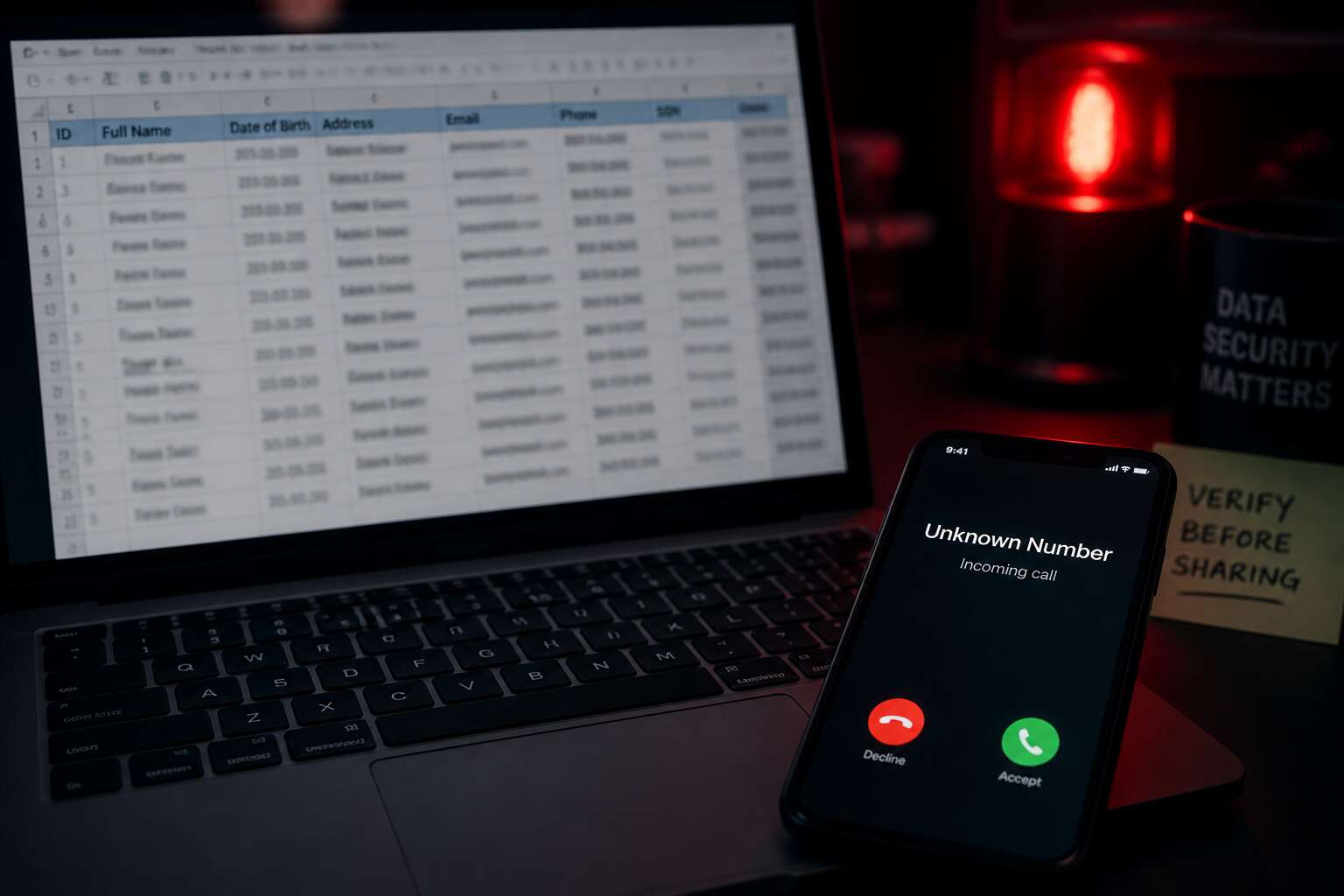
The average South African has personal details scattered across dozens of databases. The average leaked database collects those details into one neat package. Rows of names, ID numbers, physical addresses, and cellphone numbers sit in adjacent columns. Monthly income, employer, and outstanding debt appear alongside them. One spreadsheet can hold millions of these rows.
The exposed data reads as follows:
- Policy numbers and claim histories
- Banking details, sometimes including branch codes
- Device fingerprints and SIM card registrations
- Family relationships and next of kin
This specificity is what makes a south africa data leak telemarketing caller so convincing. They are not guessing your financial history. They are reading it. The database does not require consent. It requires completeness.
Case Studies: How Data Leaks Fueled Unsolicited Call Campaigns
One case study tracked a retail loyalty breach. Within weeks, a south africa data leak telemarketing operation used stolen purchase histories to pitch extended warranties. Callers named exact products and store visits. The campaign lasted until regulators intervened.
Another case involved a healthcare insurer. Stolen claim details gave callers a script. They referenced recent procedures and offered supplementary coverage. Victims described the calls as deeply unsettling. The data was current.
What made these campaigns effective?
- Income-segmented call lists
- Scripts built from purchase logs
- Verifiable phone numbers from SIM records
Each element traced to a single data breach.
The Role of Third-Party Brokers in Selling Stolen Numbers
Every south africa data leak telemarketing pipeline needs a middleman. Third-party brokers sit between the breach and the dialer, quietly curating stolen records into sellable packages. They scrub duplicates, append missing fields, and price lists by freshness. A breach from January commands a premium in March. By June, the same dataset sells at a discount.
Consider the broker’s inventory:
- Verified mobile numbers, cross-checked against SIM records
- Purchase histories, segmented by spend bracket
- Caller scripts built from leaked metadata
These brokers operate with a bureaucratic steadiness. They issue invoices, offer refund policies, and maintain client relationships. One industry insider told me their workflow is identical to a legitimate lead-generation firm, except the source documents are criminal. The entire operation feels routine, and that routine is what makes south africa data leak telemarketing so persistent. Honestly, the paperwork alone is staggering.
Legal and Regulatory Framework in South Africa
POPIA and Its Rules on Direct Marketing Without Consent
POPIA, the Protection of Personal Information Act, sets strict boundaries for how businesses handle your private details. Its rules on direct marketing without consent are unforgiving. A company cannot call you for promotional purposes unless you have agreed to be contacted. No consent, no call.
For organisations that rely on cold outreach, this law complicates any south africa data leak telemarketing strategy. If they purchase a list from a broker, they risk violating Section 69 of POPIA. The Information Regulator can impose hefty fines, and the reputational damage is worse than the penalty. I’ve seen firms argue that a number in a database implies permission. It does not.
The law demands a clear, recorded opt-in. Some marketers disguise their calls as service messages, but the distinction matters. One unsolicited call with a sales pitch is a breach. Without that opt-in, a south africa data leak telemarketing call is a statutory violation.
Your Rights as a Consumer Against Unwanted Telemarketing
The legal framework in South Africa is not a suggestion; it is a binding contract between caller and consumer. Beyond POPIA, the Consumer Protection Act gives you the power to shut down unwanted contact. You have the right to ask who supplied your number, and the caller must answer truthfully. You have the right to demand your data be deleted on the spot. You have the right to report any refusal to the Information Regulator.
If a telemarketer hesitates or becomes defensive when you ask these questions, that hesitation itself signals a south africa data leak telemarketing operation. The regulator takes a dim view of such behaviour, and enforcement actions have already started landing. Your rights are not abstract; they are practical tools.
- Request the caller’s full name and company registration number.
- State clearly that you withdraw any implied consent.
- Escalate to the Information Regulator if they call again.
Those three steps turn a frustrating call into a documented violation. The law sits on your side, ready to act when you do.
How to File a Complaint with the Information Regulator
Documenting the violation is step one. The Information Regulator’s complaint process begins where that documentation ends. Under POPIA, you can file a complaint in writing using Form 1, available on the regulator’s website. No legal representative is required, and the process costs nothing. For anyone facing a south africa data leak telemarketing intrusion, this route is the most direct available.
Prepare the following before you submit:
- The caller’s full name and company registration number.
- Dates and times of each call.
- Any correspondence or voicemail evidence.
Then send your submission to the Information Regulator’s office in Pretoria. The office acknowledges receipt and assigns an investigator. That investigator may contact you for additional detail. Your complaint becomes part of a larger pattern; the regulator examines whether a south africa data leak telemarketing network is behind repeated violations. A single report can seed a broader investigation into the data’s origin, and that is exactly what these operations fear.
Recent Penalties for Companies Involved in Data Leaks
South Africa’s legal framework treats data breaches as more than an inconvenience. The Protection of Personal Information Act, or POPIA, arms the Information Regulator with genuine enforcement powers. Penalties for companies involved in data leaks now reach administrative fines up to R10 million, enforcement notices, and criminal liability for directors who ignore their duties. Recent actions confirm the Regulator will act, which is unwelcome news for the networks behind south africa data leak telemarketing.
Enforcement has targeted organisations that collect private data, lose it to bad actors, and then watch that same data fuel unsolicited call campaigns. The legal position rests on clear obligations:
- Companies must report breaches promptly or face penalties.
- Third parties processing personal data without consent face liability.
- Individuals harmed by a leak can claim damages under POPIA.
The Regulator’s willingness to impose fines has turned south africa data leak telemarketing into a high-risk enterprise.
What the Law Says About Data Breach Notification
South Africa’s data breach notification rules create a clear chain of obligation. When a company loses personal information, POPIA requires the Information Regulator to be informed without undue delay. The law also demands notification to affected individuals, especially where the leak could fuel south africa data leak telemarketing operations.
The notification must include details about what was compromised and what steps the company is taking. This transparency serves a practical purpose: it allows consumers to brace for the inevitable cold calls that follow any south africa data leak telemarketing incident.
Consider the key requirements:
– Breach reports must reach the Regulator as soon as possible
– Affected parties need clear, specific information about the risks
– Companies must document every step they took in response
The absence of a fixed deadline has drawn criticism, but the expectation remains unambiguous: delay invites scrutiny.
Gaps in Current Legislation and Where You Are Still Vulnerable
South Africa’s data protection laws create an illusion of safety that crumbles under scrutiny. POPIA offers consumers a framework for recourse, yet the machinery of enforcement remains underfunded and reactive. Companies know this. They understand that the likelihood of meaningful penalty is low, and so they treat compliance as an administrative exercise rather than a moral imperative.
Where are you still vulnerable? Consider the gaps that persist despite the regulatory framework:
- The Information Regulator can only investigate a fraction of reported breaches
- Companies face no mandatory deadline for notifying affected individuals
- Cross border data transfers escape clear jurisdictional oversight
These loopholes create space for bad actors to operate with impunity. The promise of legal protection means little when the systems designed to deliver it are overwhelmed. Until enforcement matches the ambition of the law, south africa data leak telemarketing will continue to flourish in the shadows of good intentions.
Protecting Yourself from Data Leak Telemarketing
Practical Steps to Secure Your Personal Information Online
Every week, thousands of South Africans answer calls from strangers who know their names, addresses, and account details. That familiarity signals a south africa data leak telemarketing operation, where stolen databases become dialing lists within hours. Protecting yourself demands a deliberate tightening of your digital footprint.
Start by auditing where you share personal information. Reduce the fields you complete, use a separate email for registrations, and never publish your mobile number on public profiles. A dedicated SIM for verification codes adds another layer.
Check your privacy settings quarterly. Opt out of data sharing wherever possible. When a south africa data leak telemarketing breach occurs, your vigilance determines whether your number ends up on those lists. Small, consistent choices keep your information out of reach from those who have no right to it.
How to Handle Suspicious Calls Without Falling for Scams
When a caller already knows your ID number and your last purchase, the south africa data leak telemarketing operation is underway. I take a breath before saying anything. Your strongest move is to slow the conversation down.
Never confirm a single detail. Even a simple “yes” can be recorded and repurposed as authorisation. Instead, ask for the company name, a physical address, and a callback number. A legitimate operator provides these without hesitation. If they refuse or push for payment, end the call.
- Do not press numbers a recorded voice suggests.
- Do not call back numbers left on your voicemail.
- Do not engage with threats of legal action or account closure.
Every second you spend engaging feeds the operation. Hang up, block the number, and move on!
Using Call Blocking and Number Screening Tools Effectively
South Africa data leak telemarketing relies on numbers that are too easy to reach. Your mobile number is no longer private once it enters a breached database, so the callers arrive with confidence and urgency. Call blocking and number screening tools give you back control before the first ring finishes. Apps like Truecaller, Hiya, and built‑in Android and iOS filters let you see the caller’s identity before you answer. Robot callers are easy to identify when you use these services.
- Block numbers flagged by community reports.
- Enable silent mode for unknown callers.
- Screen calls from private or hidden numbers.
- Report telemarketing numbers after the call, which strengthens the database for everyone.
Your phone becomes a fortress when you configure these tools properly. Data leak telemarketing operations often rotate numbers, but they cannot rotate past a filter that declines anyone outside your contacts. Activate the tools, update your contacts, and let the screening work while you go about your day. Vigilance, in this form, consumes no energy at all.
Setting Up Data Breach Alerts and Monitoring Services
Every day without a breach alert is a day your details may be circulating in a shadow database. South africa data leak telemarketing operations rely on the silence between exposure and discovery. Monitoring services close that gap.
Services like Have I Been Pwned scan known leak databases for your email address and phone number. When your information appears, you receive an alert while the data is still fresh. Some South African banks and mobile providers offer similar notifications for their customers.
- Register your primary email address with a monitoring service
- Add secondary addresses used for online shopping
- Include phone numbers where the service permits it
Early warning gives you the advantage. You can change passwords, freeze accounts, and prepare for inevitable calls. South africa data leak telemarketing campaigns rarely slow down, but knowing what they hold lets you recognise a cold caller before they finish their opening line.
The Future of Data Privacy and Telemarketing in SA
Emerging Trends in Cybercrime Targeting South African Consumers
Consider this: a stolen database now sells for less than a cup of coffee, yet it fuels a growing shadow economy. The future of south africa data leak telemarketing is moving away from random cold calls. It is becoming precise. Criminals are layering leaked personal details with voice synthesis and chatbot technology to dupe even cautious consumers.
Emerging trends point to phishing-as-a-service operations that supply call centres with live-updated victim lists. These syndicates adapt their tactics faster than many organisations can patch their defences. The result? A telemarketing call that sounds eerily legitimate, right down to your correct banking branch and last transaction!
This is the new frontier of cybercrime. Stolen data has become a personalised weapon, and South African consumers are the target range.
How Businesses Can Prevent Leaks and Build Trust
The cost of a stolen database in South Africa is now lower than a loaf of bread. Yet the price of rebuilding consumer trust after a leak is incalculable. South africa data leak telemarketing has turned personal information into a tool of manipulation. Businesses supplied the raw material through lax custodianship.
The future belongs to companies that treat privacy as a core obligation. Those organisations will retain customers while careless competitors lose ground. I have watched a single leaked spreadsheet undo a decade of brand building.
Forward-thinking firms are already changing course:
- They apply data minimisation to limit what they collect.
- They vet every third party that touches customer records.
- They treat breach notification as a service to consumers, not a legal exercise.
The trajectory is clear. Businesses that ignore south africa data leak telemarketing risks will lose wary consumers. Businesses that secure their data will become the exception in a market starved of trust!
Innovative Technologies That Could Put an End to Data Exploitation
A stolen spreadsheet that yields only gibberish. That is the future data privacy experts in South Africa are working toward. Zero-knowledge proofs, which verify claims without revealing the underlying data, could dismantle this entire trade!
Homomorphic encryption lets businesses compute on encrypted data directly. A telemarketer could confirm you are over 18 without ever reading your birthdate. Synthetic data, generated from statistical models, already trains fraud detection systems without touching a single personal record.
- Blockchain consent registries prove which company received your permission, and when you revoked it.
- Automated breach detection flags stolen databases the moment they surface on dark web forums.
These are not distant experiments. European firms already deploy similar protections. South africa data leak telemarketing could become a phrase we encounter only in historical analyses, if the momentum behind these tools holds.
What the Next Decade Holds for Privacy Rights in the Country
The next decade will test whether south africa data leak telemarketing becomes a historical footnote or a recurring headline. The Information Regulator has promised enforcement, but promises are cheap. What will change is the cost of getting caught. Courts are warming to class actions, and insurers now demand data hygiene audits before issuing policies. If you do not comply, you do not get coverage.
Here is what privacy rights will likely look like by 2030:
1. Consent will be dynamic, not a once off tick box.
2. Telemarketing scripts will require proof of data lineage before dialling.
3. Breach notifications will be public within 72 hours, no exceptions.
4. Executives will face personal liability for negligent data handling.
The noisy era of the south africa data leak telemarketing pipeline is ending. The question is whether businesses adapt gracefully or get dragged into compliance by the courts.




0 Comments